
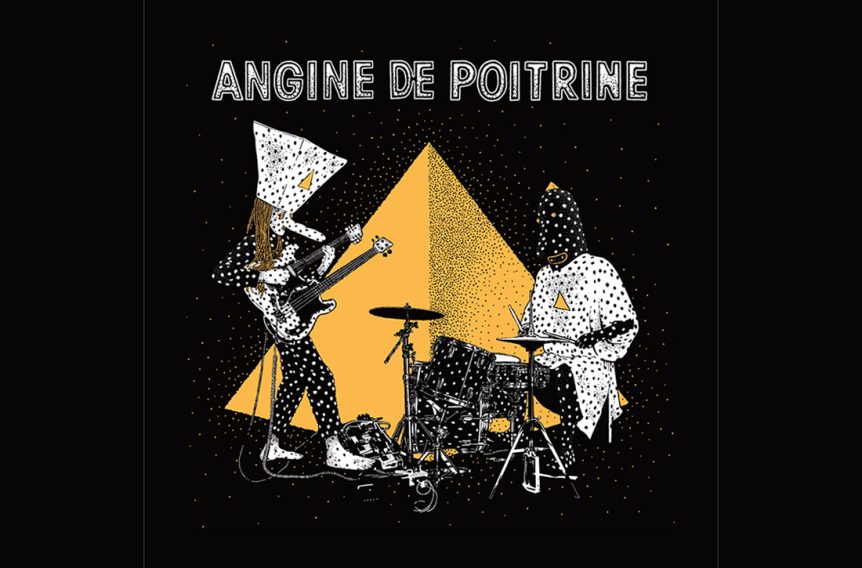
Yes, the name of the group in English is Angina Pectoris and this Québecois duo is now on the first leg of a North American and European tour, selling out stages, after footage of a December 2025 concert in Rennes, France, was released by a Seattle radio station early this February. They had just won the Best Duo Artist of the Year award at GAMIQ (Gala alternative de music independente de Québec)—Québec’s award night for emerging artists—in December 2025.
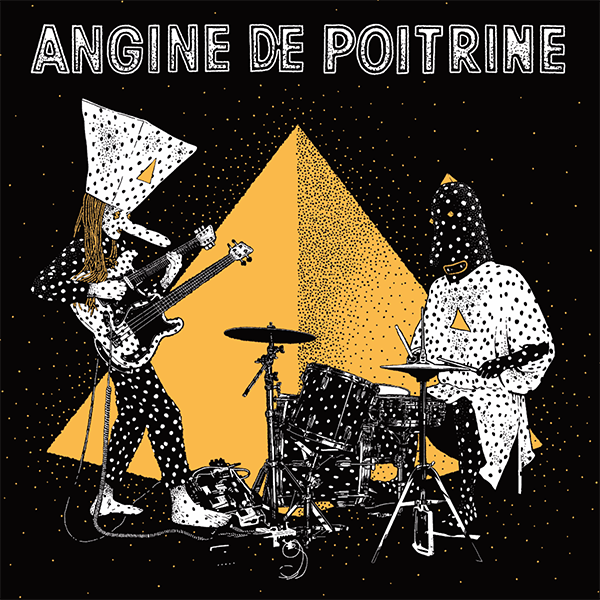
They have a genre-bending style, combining progressive rock, microtonal math music, complex rhythms and looping.
The name and their polka-dot costumes started as a gag. They had wanted to book a second night in a week at a venue. The venue’s booking agent was sceptical that a second show would attract customers, so the duo created the name and the costumes as a joke. They booked the gig, the gag stuck—and Angine de Poitrine was born.
Four aspects of their music relate to ‘games’ we play at Music for People.
Firstly, the drummer (Klek) starts by setting out a groove. The rhythms are complex and invite deep listening, to find the ONE, and to hear the polyrhythms. The drum rhythms stay constant, so they give a focus to the piece, rather than wandering here and there. As we know, a good solid groove allows a LOT of freedom to the soloist.
Secondly, some pieces start out in what we would recognize as a straight forward ‘4’ beats per measure, then drops accents in odd places. We’ve done that in our drumming circles where we put an accent in different places. (Other Angine de Poitrine tunes are in 10. Or 28. Or 17. In MLP, one of the practices is feeling a steady pulse on ONE, allowing for different meters.)
Then, the guitar player (Khn) adds a bass line and loops it. He may add several bass riffs. They’re all looped! He has a double guitar—bass and electric. Once the bass lines are going, he adds on the solos. And more loops!
Finally, the guitars’ tuning. There are twice as many frets as on normal guitars. For those interested, it produces a tuning system called ’24-tone equal temperament’ or 24-TET.
What this means is that, if you picture a piano keyboard, put a note in between each key on the piano. So a note between a white key and the next black key. Another between that black key and the next white one.
These are “quarter tones”… or microtones. These are the kind of sounds we get when we’re tuning a string instrument, or when instruments aren’t quite in tune—we hear those small notes in between. If you’re a string player of any kind, you can get a microtone by bending the string. These sounds appear in Middle Eastern music, Indonesian gamelan and Indian music, as examples.
Angine de Poitrine released their most recent album in early April. You can hear them and buy their music to support them on Bandcamp and Quboz as well as on their website. They’re also on other streaming services, YouTube-https://www.youtube.com/@AnginePoitrine and other socials.
Check out this video from the summer of 2025 at Festival Pop in Montréal. Learn more at the Angine de Poitrine website and Wikipedia. And because they’re so current, you’ll find articles galore with a very simple search!