
Long time MfPer (author of Return to Child, co-author of Simple and Daring and creator of Music Doctor Improv Cards) Jim Oshinsky has been exploring Ireland for the past 12 years, ever since taking a folklore and traditional music tour led by MfP alum Gerry Dignan. He has returned to Ireland a few times to view castles, megalithic sites, seascapes and mountains, and of course, pubs and music-playing opportunities.

During a recent trip to Ireland Jim visited the Emerald Guitars factory where some of the best carbon fiber guitars in the world are made. Once a factory tour was arranged, Jim was also contacted to set up a demonstration of Music for People improvisation activities for the company staff.
You might be curious about carbon fiber instruments. (See the link below if you’re a string or Celtic instrumentalist!)
Thanks to Jim Oshinsky for the following post about the differences between wood and carbon fiber guitars as well as a little background on Emerald Guitars in Ireland.
A little background on carbon fiber guitars:
The bane of guitarists’ existence is the instability of wood. It swells and shrinks with weather, temperature and humidity. It twists and turns in subtle but significant ways, pulling a beautifully tuned instrument out of kilter. The shifts of seasonal and regional weather means that no adjustment or fix will ever be a permanent solution.
Carbon fiber, in contrast, is both more stable than wood and hundreds of times stronger. This means it will not shift with weather, and instruments can be molded in one piece, body and neck, rather than glued together. This allows carbon fiber instruments to be more resonant than wood, as every joint and changeover in material impacts how vibrations are transferred from top to sides and from body to neck. Because of its strength, carbon fiber does not need internal bracing of its top and bottom surfaces, and it can be shaped and molded to fit the arm and hand movements guitarists naturally use when playing. Ergonomically flexible, a big plus.
If you compare a great wood guitar and a great carbon fiber guitar you will hear differences. Wood is warmer, carbon fiber is more strident and more evenly resonant. There are reasons to appreciate both sounds. But for a traveling guitarist, the lightness and stability of carbon fiber are major concerns, at least for players without roadies and their own guitar technicians. Carry a wood guitar and then carry a carbon fiber guitar 3/4ths the weight. Over time, it matters.
Emerald Guitars was founded by Alistair Hay, who learned carbon fiber molding technology working on racing yachts. The vacuum molding process involves a shell and a balloon to hold the material from the inside and outside. His artistry shows in his inspired additions to the process that impact the look of the instruments as well as the sound. He can make the carbon fiber any color, and he can embed wood veneers of any design into the carbon fiber top for amazingly stunning results. Cobalt blue sunburst spalted maple, forest green redwood burl, etc. And add in state of the art electronics for amplified playing-electric, acoustic, hybrid, and midi.
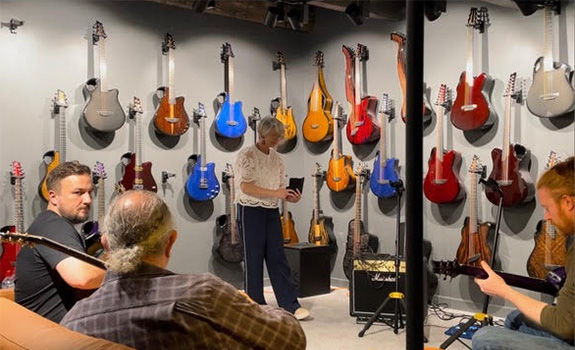
Personally, I own three Emerald instruments. A bass that projects unamplified like no other, a 12 string octave-up guitar that sounds like a mandolin, and a parlor guitar for travel and gigs. They all have a plain black carbon fiber finish, since the sound is what I am after. I also bought them all second-hand and saved considerable bucks. Carbon fiber instruments are expensive, but worth the investment.
Even if you’re not a guitar player, carbon fiber is being used to make string instruments. (Here’s an article for string players considering carbon fiber.)
-Jim Oshinsky