
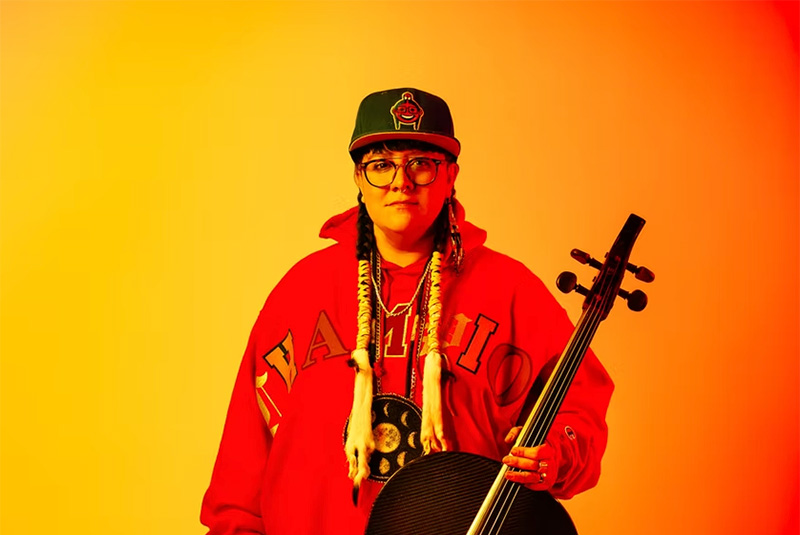
Indigenous cellist and composer.
Genre-defying, world opening, trail blazer.
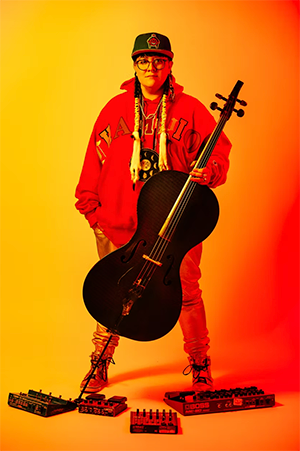
As a child, Cris Derksen wanted to play flute, then sax, then double bass. She played piano and clarinet at a performing arts high school in Edmonton, before deciding to learn the cello for two reasons. Firstly, it fit into her mom’s car and, secondly, it’s more versatile than the bass.
Classically trained (BMus’07, Music Performance, University of British Columbia) she wanted the classical training, history, discipline and techniques, but was never after a chair in a classical orchestra. Cris had started playing her own music at folk festivals, along the way meeting acclaimed Inuk throat singer, improvisational singer and avant-garde composer, Tanya Tagaq, who soon had her playing internationally. Derksen’s music makes heavy use of a loop station, drum machine, guitar multi-effects guitar pad and a synthesizer.
Cris hails from Treaty 8 (Treaty No. 8, signed in 1899, encompasses land at the northeastern edges of British Columbia, the north of Alberta and northwest of Saskatchewan). Her father came from a lineage of chiefs from the North Tall Cree Reserve (in Alberta); her mother comes from homesteading Mennonites. Her music weaves these traditions with her classical training and modern electronic elements. “Both my heritages are quite dichotomous from each other,” the 2-Spirit artist said in an interview at the TRANSFORM Festival. “The Mennonites are quite religiously strict, and my Indigenous family has a different sort of spirituality, so they’re quite different from each other. Because of my upbringing, I’m able to come to the table with a perspective of being both from the land and a settler to the land.”
She has been writing and improvising since childhood. “I’ve always played my own music,” she says. “My piano teacher told my mom, ‘I don’t think piano is what Cris is good at.’ My mum thought that was weird, because I would practise every day for more than an hour. So she came to my lesson, and I sat down and looked at the notes on the page and went ‘plunk.’ And then I looked at the next chord, and went ‘plunk.’ My mum said, ‘That’s not what you’ve been playing at home.’ And I said, ‘Oh,’ and played the song that I made up. So I’ve always been creating.”
It’s difficult to summarize or categorize Cris’ trailblazing musical accomplishments, because they do not fit into any one box. Not even a very large one. To give you an idea, here’s are just a few of her accomplishments over the past 20 years. The list will also give you a bit of a roadmap to discovering her work.
- Her debut album, The Cusp, remains a staple on the CBC and is frequently licensed for television and film.
- She’s been a staple of the Canadian Folk Festival circuit, performing with her quartet and indie bands.
- Dersken has performed with 15 different symphonies and chamber orchestras across Canada and toured around the world.
- Composer at the Canadian Pavilion at the World Expo in Dubai and then in Osaka.
- Her work on the podcast “Stolen: Surviving St. Michael’s” by Connie Walker and Gimlet Media earned both a Pulitzer Prize and a Peabody Award.
- Played at Carnegie Hall, premiering a commission from Yannick Nézet-Séguin called “Controlled Burn.”
- Wrote a ballet for Ballet Kelowna; worked with the Winnipeg Ballet
- Premiered a work for choir on water sovereignty.
- Wrote a “Prayer for Water/Mass for Nîpîy” for choir, and drum choir, piano, French horn, cello and drum kit.
- Has composed for symphonies, chamber groups, dance, theatre, TV, podcasts, fashion, film.
- Awarded a Dora Mavor Moore Award, an Indigenous Music Award, and an Aboriginal People’s Choice Award.
- Juno nomination for “Orchestral Powwow” in 2015.
- Most recent album is The Visit from November 2025. From that album, here’s a link to “Nice and Clean”, which incorporates audio from a 1967 NFB movie about indigenous resettlement as well as Dersken introducing the piece.
- Founded the Indigenous Classical Music Gathering.
About the Indigenous Classical Music Gathering Dersken said, “I’ve been around for quite a while as an Indigenous musician, and I realized that I knew so many Indigenous musicians that were a part of the folk or pop world, but I didn’t actually know a lot of my peers in the classical world…. I realized that we needed to build that network and that relationship with each other.
“It was really cool to be in a room full of people like me, unboxing the traumas of classical music, and finding common ground of listening to scores together or doing score study together,” Dersken says of the first Indigenous Classical Music Gathering in 2019. “It was so cool to be in a room jamming out on Stravinsky. It was so nerdy and also so beautiful. And really, what it did was open the door for the Canadian classical community to remind ourselves that if we wanna do Indigenous works, we should hire Indigenous people to do the works.
The Juno-nominated “Orchestral Powow” piece from 2015 is really unique. Dersken conceived of this as a studio project, but it took on a life of its own on the road. Think of it as a meeting between First Nations powwow groups—Northern Voice, Black Bear, and the Chippewa Travellers—and a small chamber orchestra led by Dersken. But without a conductor. This created an interesting opportunity for all the musicians. The classical musicians have to follow the beat of the drum rather than the upbeat and signals from a conductor. “We have to follow the beat of the powwow drums, so we have to follow the indigenous heartbeat first,” she says. “This involves an intense amount of listening from the European players—which is also an allegory for what should happen, what needs to happen! A huge amount of listening and following: that’s the goal!”
Sharon Little, one of our MLP Grads, first heard Cris live, soloing outside on a market square near the end of the pandemic. “Much of the music at this summer festival in Stratford, Ontario is at least classically or jazz- connected. This was not that,” she said. I had to listen with different ears because I didn’t have any reference points. This was the first time I’d heard her. But with the loops, the effects, the ways she used the cello other than with a bow, I could bridge that to what we do in Music for People. The combination of Indigenous sounds with the electronic elements, her voice, and the stories she told was riveting.”
Dersken was one of several Indigenous artists at a May 8 concert, Wanuskewin, Seeking Peace of Mind in Toronto with the Amadeus Choir. There she presented a new arrangement of “Mass for Nîpîy: A Prayer for Water.” Her father had just died, and she left after the concert for his funeral.
On Friday evening, May 15, she and her wife and collaborator, singer Rebecca Benson, were driving back from Dersken’s father’s funeral in TallCree First Nation, near Fort Vermilion in Alberta. Another SUV, driving north at high speed, crossed the line and crashed into their SUV. Dersken died from her injuries. Her wife and the driver of the SUV were both critically injured and, at last report, remain in hospital.
Cris was 45.
Tributes have been pouring in from all corners of the Canadian musical world. Here are two of them:
The National Arts Centre praised the internationally respected musician for bringing “a powerful and unmistakable voice to contemporary music, weaving together classical training, Indigenous traditions, and electronic innovation. Their work resonated across the country and the world.”
Calgary Folk Music Festival remembered her Sunday as a composer, mentor, and performer who “stretched traditional and contemporary boundaries while remaining deeply grounded in her identity, story, and unique sound.”