
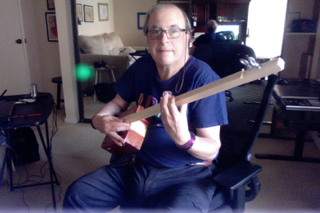
Jonathan Brandstater, from Florida, graduated last year from the Musicianship program of the MLP. He found knowing that improvisation was THE thing in MfP was really helpful as he doesn’t have a vast background in ‘formal’ musical training.
He’s also been a regular participant in the Collab Labs. He particularly likes to use homemade instruments—some from kits and, more often, from instructions online.
He says “Improvisation allows you to go with the flow and assure you there are no wrong notes. The challenge lies in starting out and not worrying about whether the improvisation will sound good or not!” He adds, “Music for People assured me there are alternatives to the “traditional” rote way of learning, playing and singing music.”
How did you find Music for People?
I had taken an interest survey and results seem to suggest I had interests in common with Music Therapists. I ran a search for Music therapists on Facebook and found reference to Music for People, bookmarking several pages and the website. What intrigued me was the emphasis on improvisation.
I discovered I have less in common with music therapists than I thought. Knowing I could find like-minded people connected to Music for People made up for what was a false lead.
What inspired you to join the MLP?
Knowing the emphasis was on improvisation was very encouraging. Various content, especially the videos on the website suggested I could do well with the program.
What did you want to get out of it?
Learning is important to me. Specifically, I was looking for alternatives to what I thought were limited options associated with music: I could be a professional musician/performer, music teacher or music therapist. And supposedly there was only one way to go with each option. MLP suggested there were other options such as the role of facilitator. In addition, I didn’t need to limit myself to playing someone else’s music. I could play my own music and improvise, too.
What are three things that the training and total experience have taught you?
From the Bill of Musical Rights: There are no wrong notes. Silence is your friend. Babbling is not just fun but a great way to “break the ice” and open a world of possibilities, music-wise. In a supportive, non-judgmental atmosphere as provided by MfP, I can thrive.
How have you changed?
I have become more confident. I have developed skills I did not know I had. Some people have even complimented me and told me, “Thank you for facilitating.” Then again, I can play and sing music without being so concerned about making mistakes. As far as Music for People is concerned, the emphasis is on enjoyment instead of approval seeking and people pleasing.
You’ve been active in the Collab Lab: what has that experience been like?
I felt like I was in my element. There have been a few experiences in my life where I participated in informal jam sessions. To some extent, with Collab Lab, I was doing the same, even though I have not met any fellow participants face to face. Still, the end results were incredible. As for the actual sessions, I learned something new each time.
Why did you participate in the Collab Lab?
I participated for the fun and challenge. Besides, I found what I contributed made a difference. It wasn’t just about the music I made. There was the cooperation and opportunities to help out. Evidently, I was picking up and practicing skills as a facilitator as I went along. Certainly being open-minded, flexible and inclusive helped.
For those who don’t know, how would you describe Collab Lab?
A typical Collab Lab consisted of three consecutive weekly Zoom meetings, each one hour long. Instead of playing together in the manner of a jam session, we each contributed audio tracks for one piece at a time. The first participant contributed a “foundation track” while others added their own tracks. A person creating the foundation track may invite other people to collaborate. It is up to other group members to decide whether or not to accept the invitations. Along with Soundtrap, there was another website of interest: Padlet. Here, we could post audio files and collaborations we especially enjoyed to share with other people.
Describe the inspiration for your Capstone Project for the Musicianship Program.
I found myself improvising and playing a lot of blues music on Soundtrap. I think part of the reason was also that I heard a lot of blues riffs demonstrated during the monthly MLP meetings. Alina and, I think, Mary both advised me to do something with blues music for the capstone project and I agreed. Originally, Alina suggested I record five pieces and I did so. The idea was also to invite people with whom I collaborated on Soundtrap to contribute to the Capstone Project as well. One participant further advised me to add a sixth piece because the results seemed especially impressive to her. So I followed through.
Listen to Jonathan’s Capstone Project on Padlet using various instruments and contributions of Collab Lab members.
You bring a lot of home made instruments to your playing. How did that develop and evolve?
There were precursors in the form of three Do It Yourself (DIY) kits. In no particular order, they were a set of pan pipes, a clay ocarina and a Japanese zither known as a koto. The real beginning was when I was at a local library searching for information about blues and jazz. I got sidetracked when I noticed “Musical instrument construction” and searched for more information about this instead. I borrowed a few books about how to make simple instruments and became hooked on making instruments. I also ran internet searches. In more recent years, I resumed building instruments from Do It Yourself kits.
Besides instruments from kits, I have made several of my own designs. My sources of inspiration are books about experimental instruments. Very often, the experimental instruments I build take less time to assemble and I enjoy building them more than the ones I have built from kits. I don’t worry so much about making mistakes. According to builders of one particular instrument, the cigar box guitar, there are no rules for building or playing it. Knowing this is a great relief!
Improvisation is…
…both easy and challenging. Improvisation allows you to go with the flow and assure you there are no wrong notes. The challenge lies in starting out and not worrying about whether the improvisation will sound good or not!
Music for People…
…assured me there are alternatives to the “traditional” rote way of learning, playing and singing music.
Links to Jonathan’s Music:
https://www.songcastmusic.com/profiles/JonathanJB